The company isn't growing slowly because the market is hard, the team is weak, or the strategy is wrong.
It's growing slowly because every important decision still goes through one person. And that person is already at capacity.
If you founded the company, that person is probably you.
This is the founder bottleneck. It's one of the most documented problems in scaling companies, and it's almost always invisible to the person causing it.
Early-stage companies are built on founder involvement. You made the calls. You set the direction by showing up, pushing, deciding. The team ran on your judgment, your relationships, your read of the market.
That was the right model. A 10-person company needs speed, not process. The founder's direct involvement was a competitive advantage.
At 50, 80, or 150 people, it becomes the problem.
The organization has grown, but the operating model hasn't changed. Strategy still lives in your head. Priorities shift when you shift. Decisions route through you, sometimes formally, often informally, because people have learned that's how things actually work around here.
What used to be a feature is now a structural constraint.
Research by Kaplan and Norton, creators of the Balanced Scorecard, found that 95% of employees in most organizations can't describe their company's strategy.
Not a rough sketch. Not the three main priorities. The strategy.
That number isn't surprising once you understand the mechanism. When strategy only exists in conversations, in the founder's 1:1s, in their head during product reviews, in the intuition they carry into every room, it doesn't travel. It can't. It has no form anyone else can hold onto.
MIT Sloan research adds another layer: only 28% of managers responsible for executing strategy can identify their company's top three strategic priorities. These are the people who are supposed to be translating direction into action. They're largely guessing.
The consequence? Teams execute in slightly different directions. Each person has a plausible interpretation of what matters. Nobody's wrong, exactly. They just don't have the same map.
Harvard Business Review puts the result bluntly: 67% of well-formulated strategies fail due to poor execution. Not bad strategy. Poor execution of good strategy. The bottleneck isn't the idea. It's the translation.
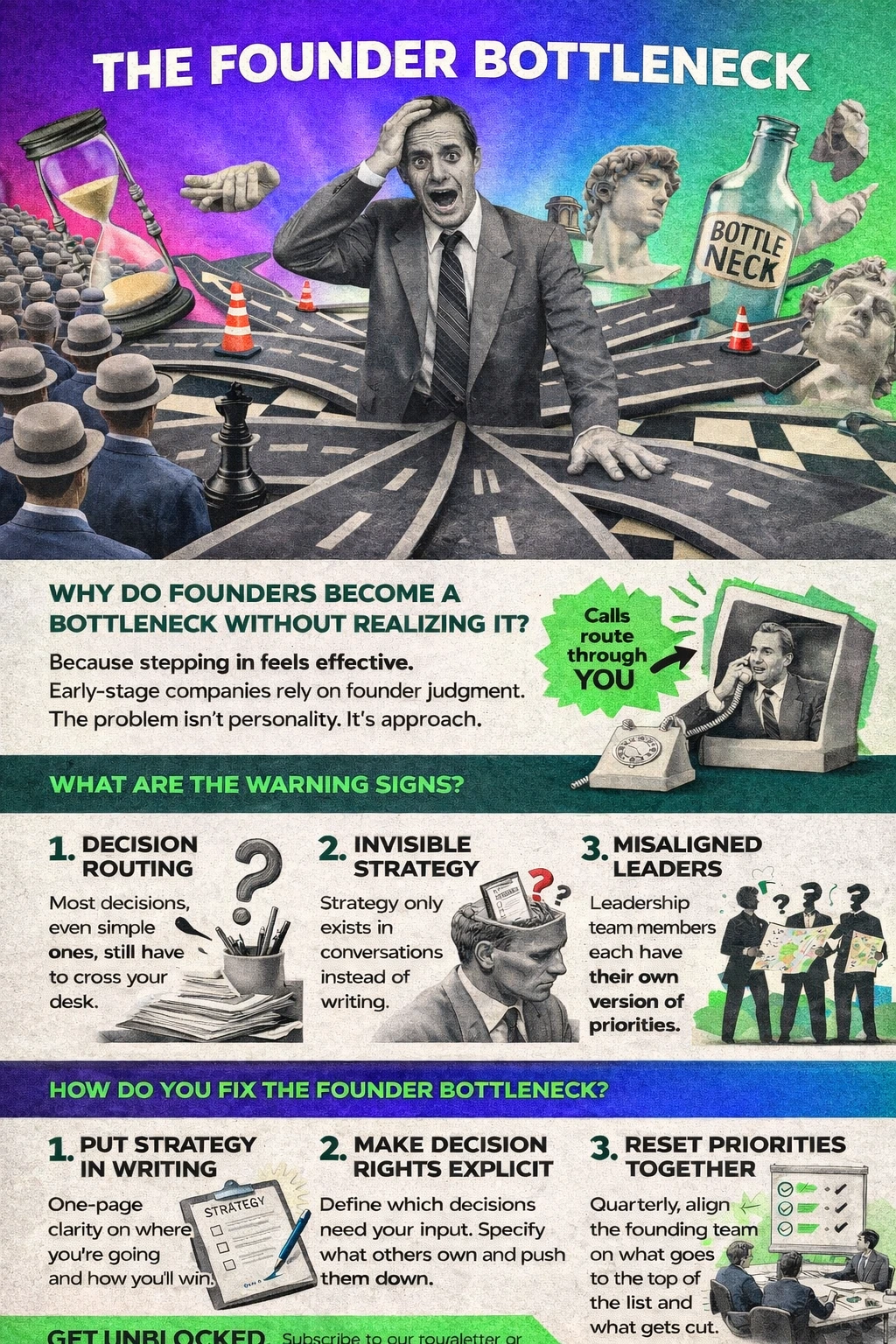
Here's the thing that makes this pattern so persistent: stepping in feels effective.
When the founder jumps into a decision, things move faster. Their experience compresses the cycle. The team gets an answer and moves. In the moment, involvement looks like leadership.
John Hamm wrote about this in Harvard Business Review back in 2002, and the observation hasn't aged at all: the habits and skills that make entrepreneurs successful are exactly the ones that undermine their ability to lead larger organizations. The problem isn't personality. It's approach.
Founders fall back on what worked before, because it still works, just at a smaller scale than the company now requires.
Over time, the team learns something else. They learn that the founder will decide anyway, so why build the judgment muscle? Why push through the discomfort of an ambiguous call when they can wait for clarity from above? The organization becomes calibrated to your bandwidth, not to market demand, not to customer needs, not to the opportunity in front of it.
Growth gets capped at one person's capacity. And that person is already running at 100%.
The reason founders are the last to see it is that the signals are subtle. The team looks engaged, and projects move forward. In ideal cases, revenue grows. But decisions slow down, good people quietly grow frustrated that they can't operate autonomously, and the execution gap between what the company could do and what it actually does keeps widening.
I walked into a 60-person company where the founder was still the only person who knew the full strategy. Not because he was controlling or micromanaging. He wasn't. He was brilliant, trusted by the team, and deeply committed to their success.
But the strategy existed in his head as a living, evolving set of priorities he updated constantly as he learned. His leadership team each held a piece of it. Sales, Product, and Operations all had a different version. They were all plausible and all partially correct. But all versions were also slightly misaligned.
Every cross-functional decision required him in the room because he was the only one who had the whole picture.
He had no idea that was the structure until we mapped it together. He thought he was being available. He was actually being the system.
This is exactly the pattern we see in most of the companies we work with at Stun & Awe. It's not a character flaw. It's a structural one.
The founder bottleneck doesn't get solved by delegation pep talks or org chart changes. It gets solved by externalizing strategy, turning what lives in one person's head into something the organization can hold, use, and act on without you in the room.
That means three concrete things.
First, strategy has to exist in writing and in a form that's simple enough to actually cascade. Not a 40-slide deck. A one-page view of where the company is going, what it's not doing, and how it will win, clear enough that a new manager in month two can explain it to their team.
Second, decision rights have to be explicit. Not every decision needs the founder. But until you name which ones do, everything routes up by default. Specify the decisions that require your sign-off, and push the rest down with the context people need to make them well.
Third, build a rhythm for resetting priorities. Hamm describes a founder who gathered his senior team every quarter to force a single output: pick three priorities from a list of ten, and explicitly let go of the other seven. The hardest part wasn't choosing the three. It was releasing the seven. But the team came out of every session with something they could all act on. As one of his executives put it: they might be wrong, but they weren't confused. That's a higher bar than most leadership teams actually clear.
McKinsey's research on leadership health is worth sitting with alongside all of this: organizations in the top quartile of leadership effectiveness have EBITDA nearly double that of their peers. The gap between a company that has distributed leadership and one that has founder dependency is not marginal, but structural.
The fastest diagnostic is simple: count how many decisions landed on your desk this week that shouldn't have.
If the answer is more than three, the bottleneck is real. The next question isn't "how do I delegate more." It's "why do decisions route through me, and what would need to be true for them not to?"
Start there. The answer to that question is your roadmap.
If you want a faster read on where the drag is coming from, browse more articles on the Stun & Awe blog or get in touch to run a diagnostic on your company.
***
Michel Gagnon is a growth strategist and founder of Stun & Awe. He works with CEOs of 50-150 person companies to build execution systems that don't depend on one person. Subscribe to our newsletter or book a diagnostic call to see where the bottleneck is in your company.
The founder bottleneck is what happens when a company's growth gets capped by one person's capacity. Every important decision routes through the founder, strategy only exists in their head, and the team executes in slightly different directions because nobody else has the full picture. What was a competitive advantage at 10 people becomes a structural constraint at 50 or more.
Because stepping in feels effective. When a founder makes a decision, things move faster immediately. Over time, the team stops building its own judgment and waits for direction instead. The signals are subtle (projects still move, revenue still grows) so the founder rarely sees the pattern forming. As Harvard Business Review researcher John Hamm noted, the problem isn't personality. It's approach: founders fall back on what worked before, because it still does, just at a smaller scale than the company now needs.
The clearest sign is decision routing: if most decisions, even ones that don't require the founder's expertise, still end up on their desk, the bottleneck is real. Other signs include strategy that exists only in conversations rather than in writing, leadership team members who each hold a different version of the company's priorities, and cross-functional decisions that stall whenever the founder isn't in the room.
There are three concrete moves. First, externalize strategy into a written, one-page format simple enough for any manager to explain to their team. Second, make decision rights explicit - define which decisions require founder sign-off, and actively push the rest down with context. Third, build a quarterly rhythm where the leadership team picks three priorities from a longer list and formally releases the rest. The goal is a team that can act without you in the room, and that can tolerate being slightly wrong in exchange for moving.
No. It means the founder shifts from being the system to designing the system. Distributed leadership doesn't mean abdication - it means the company can move at market speed rather than at one person's bandwidth. McKinsey research shows that organizations in the top quartile of leadership effectiveness have EBITDA nearly double their peers. That performance gap comes from building leadership depth, not from founders stepping back entirely.
It usually surfaces between 30 and 80 people, when the organization becomes too large for informal coordination but hasn't yet built the management infrastructure to replace it. The founder's involvement, which drove speed in the early days, starts creating delays instead because there are simply too many decisions flowing through one person. By 100 to 150 people, the bottleneck is almost always visible in slowed execution, misaligned teams, or high turnover among senior hires.
Hamm, J. - "Why Entrepreneurs Don't Scale", Harvard Business Review (December 2002)
Kaplan, R.S. & Norton, D.P. - The Balanced Scorecard (Harvard Business School Press). Strategy communication research showing 95% of employees cannot describe their company's strategy.
MIT Sloan Management Review - Research on strategy execution showing only 28% of managers can identify their company's top three strategic priorities. [Verification needed - search: "MIT Sloan strategy execution priorities research"]
Harvard Business Review - "When Strategy and Execution Fall Out of Sync" (2026)
Harvard Business Review - "What Leaders Get Wrong About Strategic Alignment" (2026)
McKinsey & Company - "Ready, set, scale: Shaping leaders for hypergrowth"
McKinsey & Company - "Untangling your organization's decision making"
Gallup - State of the Global Workplace reports on employee engagement and strategic clarity (2024)
Journal of Business Venturing - Longitudinal research on founder role evolution as companies scale