
There's a moment that almost every founder I've worked with can describe precisely. The company is growing well and the revenue is up, but something has shifted. Decisions that used to take an afternoon now take a week. The team is working hard, but not quite together. Your best people look frustrated even though nothing obvious has gone wrong.
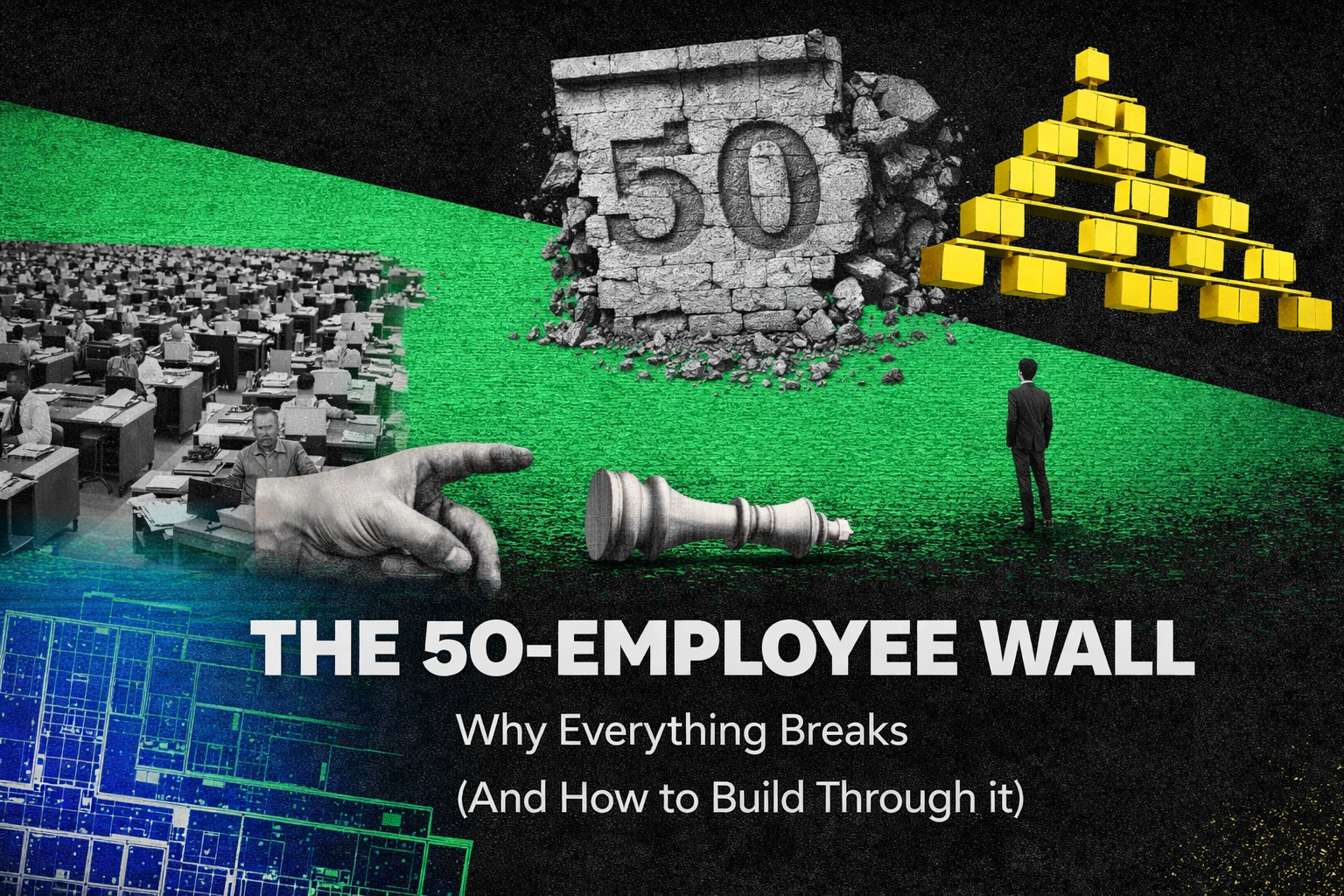
You haven't done anything wrong. You've hit the 50-employee wall.
This moment is so predictable, so consistent across industries and geographies, that it almost feels scripted. And yet most founders are caught off guard by it, because the signals are ambiguous and the diagnosis is usually wrong. The temptation is to read it as a people problem. It isn't. What you're looking at is an architecture problem.
The company you built was designed for a team of 20. Informal coordination worked. Culture spread by osmosis. You were in most of the important conversations. Strategy lived in your head, and your proximity to the work ensured that most of the team was pointed in roughly the same direction.
At 50 people, that architecture stops working. The organization has become too complex for informal coordination, but most founders haven't yet built the formal systems to replace it. The result is a company that feels increasingly chaotic, with a team that is busy but not aligned, and a leader who is exhausted and somehow still the bottleneck.
The first thing that cracks is management. Not the absence of managers, but the absence of real management infrastructure. Most companies at this stage have promoted their best individual contributors into people-manager roles without giving them the tools, training, or clarity to actually manage. You now have a layer of people doing two jobs poorly rather than one job well. And because nobody named the transition explicitly, they often don't realize it has happened.
The second thing that breaks is culture. In the early days, culture didn't need to be explicit. It was transmitted through direct observation. New hires learned by watching you and the founding team. At 50 people, new hires are learning from people who learned from people who learned from you. The signal degrades fast. What you called culture becomes a set of loosely held assumptions that different parts of the company interpret differently, and the gaps only become visible when something goes wrong.
The third thing to crack is accountability. Informal accountability worked when everyone knew everyone and social pressure kept people aligned. As the team grows, that social fabric loosens. Without explicit systems for goal-setting, progress visibility, and consequence, work becomes less predictable. Projects slip. Priorities drift. People start optimizing for looking busy rather than delivering results.
The typical response to hitting the wall is to hire senior people. Bring in a VP of Operations, a Head of People, maybe a Chief of Staff. This helps, but it doesn't solve the underlying problem if there's no leadership architecture for those people to operate in.
Adding titles without a decision-making framework creates a new problem: too many people with authority and no clarity on how to use it. The dynamic where the highest-paid opinion consistently wins regardless of the evidence often gets worse as the leadership team grows, not better. If you've seen this pattern in your company, this piece on the HiPPO effect is worth reading carefully.
More all-hands meetings don't solve it either. Communication volume is not the same as communication clarity. A company can have daily stand-ups, weekly all-hands, and monthly town halls, and the team still won't know what the actual priorities are if nobody has made the underlying decision-making structure explicit.

Leadership architecture is the set of structures, rhythms, and systems that allow a company to coordinate without the founder in every room. It has three components.
The first is decision-making clarity. Who has authority over what, and how are decisions made when people disagree? Without this, every consequential decision routes back to the top and the founder becomes the bottleneck inside the company they built.
The second is a cadence of accountability. Not annual performance reviews, but a weekly operating rhythm where teams set intentions, review progress, and surface blockers. This replaces the informal accountability that worked at 20 people with something that actually scales.
The third is explicit culture. Not a slide deck about values, but a set of observable behaviors that are modeled, rewarded, and corrected consistently by the people who manage others. Culture, at this stage, is not what you believe. It's what you repeatedly do, and what you tolerate.
Building this architecture used to take years. Teams that get the human system right first and then layer AI deliberately on top can compress that timeline significantly. AI agents that track decisions, surface blockers, and keep accountability visible in real time don't replace management. They make it easier to actually do it, and they make the system resilient even as the team keeps growing. The companies building this combination now, human architecture with AI execution infrastructure, are going to have a structural advantage within the next two to three years.
Pick one of the three things that breaks first, and map where yours is failing.
If decisions are routing through you constantly, the problem is decision-making clarity. If your best people are starting to look disengaged, the problem is likely culture drift or a management layer that isn't equipped to lead. If projects are slipping without explanation, the accountability system needs to be rebuilt.
You don't need to fix everything at once. You need to correctly identify which crack appeared first, because the order matters. Fixing accountability before you've fixed your management layer just adds overhead to a system that can't carry it.
If you're not sure which one to start with, the patterns your best people describe when they're frustrated will tell you almost everything. And if they're already starting to look for the exit, this is usually what's driving it.
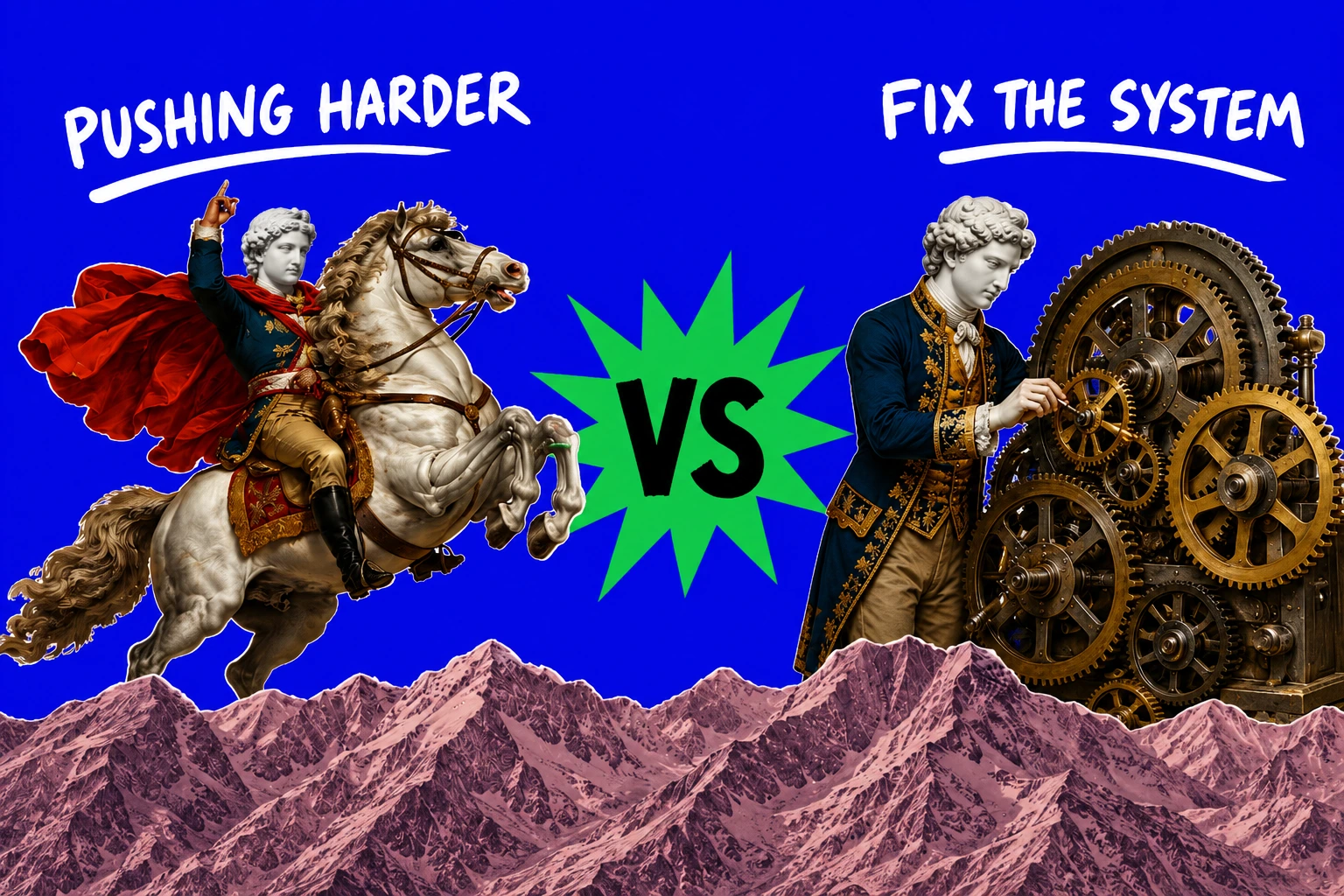
The 50-employee wall is not a sign that something went wrong. It's a sign that something went right: your company grew past the point where informal coordination could hold it together. The founders who build through it are the ones who stop trying to work harder inside an old system and start designing the architecture that the next stage of growth actually requires.
If you want to think through where your specific architecture is breaking and what to build first, a one-day intensive is often the fastest way to get that clarity.