
In 2006, I was teaching at Kaifeng University in China. One afternoon, chatting with students between classes, I mentioned I'd fallen completely in love with jiachang tofu, a classic spicy homemade tofu originating from Sichuan. The next day, the professors' cafeteria served exactly that.
I told myself it was a coincidence. So I ran an experiment.
A few days later, I casually mentioned to some students how much I also loved xiaolongbao (soup dumplings). The next day, tada! I was eating xiaolongbao.
I was in my twenties, living on the other side of the world, and I had apparently become the kind of person whose offhand food preferences influenced institutional catering decisions. I had no authority over what got cooked. I'd just said something out loud, and the people around me had quietly made it happen.
I thought it was funny at the time. Then I started running companies.
When you're the most senior person in the room, people adjust to what you say, more often and more automatically than you'd expect. A passing comment quietly becomes a directive, a mild preference turns into a project, and nobody in the room meant for any of it to happen.
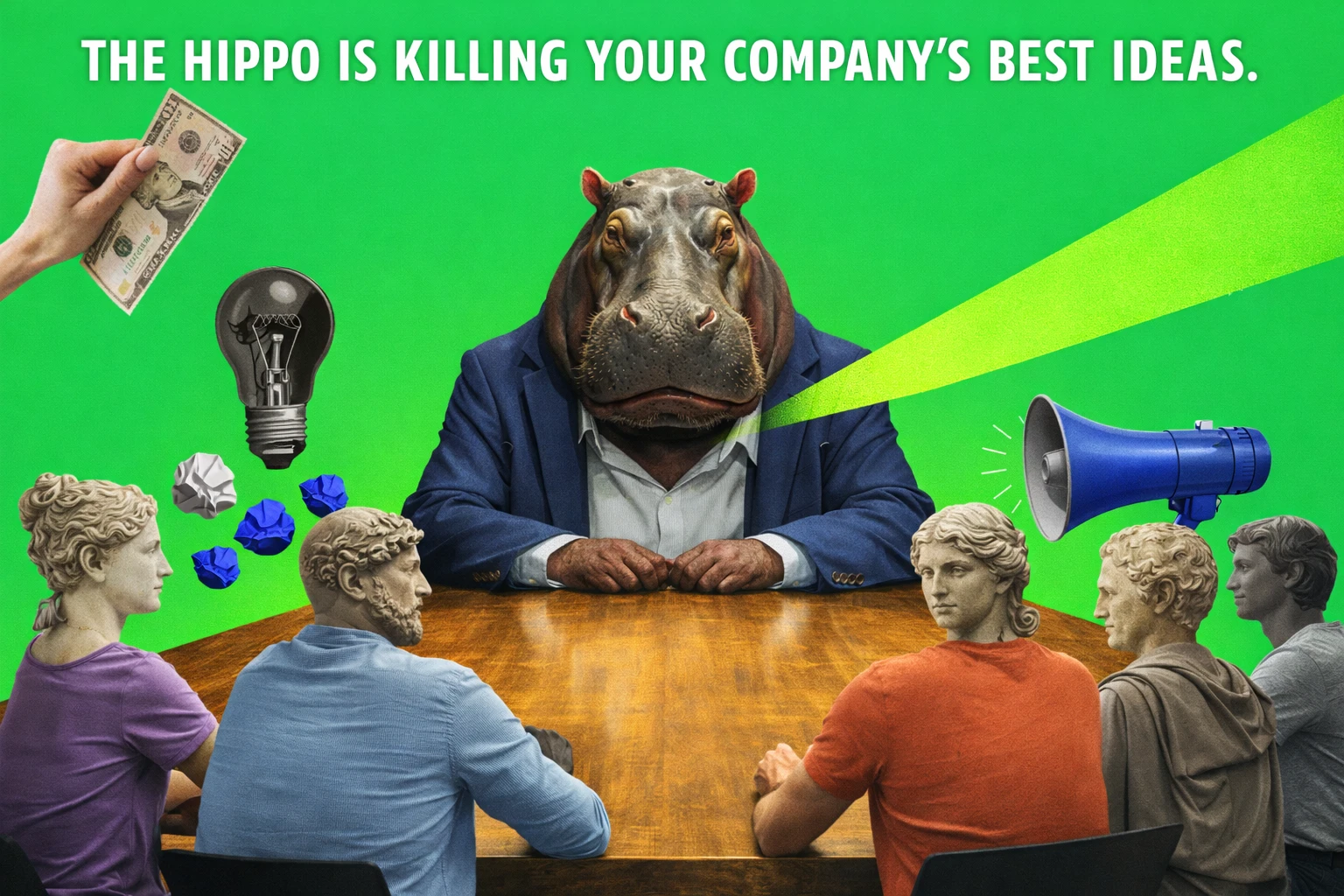
This is the HiPPO effect (a.k.a. Highest Paid Person's Opinion), and if you're the CEO of a 50 to 150-person company, it's running in your meetings right now, whether you're trying to prevent it or not.
Avinash Kaushik coined the term in 2007, writing about analytics and web strategy. He noticed that even when the data pointed clearly in one direction, teams would wait to see which way the most senior person leaned, then follow. He compared it to a hippopotamus: deceptively fast, hard to stop, and capable of crushing everything in its path.
The analogy holds two decades later. The HiPPO isn't always a tyrant. In fact, that's what makes it so hard to spot. Most HiPPOs aren't bad leaders. They're just human. They have opinions, they share them, and everyone else in the room adjusts, not because they're told to, but because that's what authority does to groups.
This is called authority bias. Humans are wired to attribute greater accuracy to opinions from high-status figures. It's a shortcut. It saves cognitive effort. It also means your best ideas, the ones from the engineer in the back of the room, the customer success lead who hears what clients actually say, die in silence before they ever get a fair hearing.
The HiPPO doesn't need to be loud. It doesn't even need to speak first. Sometimes a slight eyebrow raise from the founder is enough to end a conversation that hadn't technically started yet.
Think about the ideas that weren't brought up in your last three strategic meetings. Think about the team member who suggested something in passing, got a lukewarm response from leadership, and stopped suggesting things after that.
Marty Cagan has spent thirty years studying why some product organizations build category-defining products and others run feature factories. His diagnosis is consistent: in most companies, product teams aren't empowered problem-solvers. They're order-takers. They execute what leadership decides. The result isn't just slower innovation. It's the slow hollowing out of the team's best thinking.
I experienced this firsthand running plista, a 100-person tech company. We had talented people and genuine flashes of brilliance. But great ideas got bogged down in the wrong conversations, presented as sales pitches rather than honest proposals. The team spent energy on persuasion instead of validation. The most senior voices in the room were setting the agenda, and the evidence was politely waiting outside.
The invisible cost isn't the bad ideas that move forward. It's the good ones that were never suggested because someone decided, quietly, that it wasn't worth the risk.
Here's how it usually plays out. Your team prepares an idea. Before the formal meeting, they do the rounds, checking in with key stakeholders, softening resistance, building coalitions. By the time the idea gets presented, it's been shaped and reshaped around what leadership is likely to accept. The genuine insight has been sanded down into something presentable, which is to say something safe, which is to say something far less interesting than what they originally had.
Then in the meeting itself, the HiPPO speaks first, or speaks with enough conviction that the room stops questioning. This isn't malicious. It's just what happens when psychological safety hasn't been built, interaction by interaction, meeting by meeting. As Amy Edmondson's research shows, safety isn't a policy. It's a climate. And when that climate doesn't exist, people optimize for survival rather than for the company.
A while ago, I interviewed David Pereira, author, product leader, coach and former CEO of Omoqo. He told me he had to completely change how he showed up in meetings, because a simple statement from him, even a casual observation, could inadvertently become a formal directive. His team would interpret his passing thoughts as marching orders. So he made one shift: he started asking questions instead of making statements. He traded declarations for curiosity. The quality of ideas in his meetings changed.
It sounds almost too small a change to matter. It isn't.
You can't eliminate seniority. You don't want to, because experience matters, especially in a world of AI and robots. But you can restructure how ideas get evaluated, so that merit gets a fair shot alongside rank.
Jonathan Rosenberg, who helped build Google's product strategy, was explicit about fighting the HiPPO. He believed it would "stifle creativity and slow progress," and Google deliberately designed its decision-making culture around that belief. Not because senior leaders lacked judgment, but because judgment improves when it's challenged.
When you shrink the HiPPO, a few things start happening. The quality of ideas improves because more of them survive long enough to be tested. Team engagement goes up because people feel like their thinking matters. Decision speed actually increases because you're not running everything through one person's gut. And the leaders themselves get better, because they're getting honest input instead of a curated version of what people think they want to hear.
I've seen this shift in companies I've worked with. It rarely requires a culture transformation program. It usually requires one leader who decides to ask more questions and make fewer statements. Someone who creates enough space that the room stops reading their face for the answer.
The HiPPO doesn't survive curiosity. It survives certainty.
If your meetings feel too smooth, if ideas get approved too easily, if your team rarely pushes back, that's not a sign of alignment. It's a sign the animal has settled in and everyone has simply learned to work around it.
One thing to do this week: In your next idea-evaluation meeting, ask the most junior person in the room to share their perspective first, before any senior voice weighs in. Watch what happens to the quality of the discussion.
Want to build a team that generates and tests great ideas faster? → Fast-Track Innovation Workshop