
There is something revealing about how companies respond when their teams aren't performing the way they should. The instinct, almost without exception, is to add information. The add more training sessions, abetter methodology document or a revised onboarding deck. The implicit assumption is that people don't know what to do, and that knowing will lead to doing. It almost never does.
The playbook I built for my client's sales team was thorough, well-structured, and full of the right thinking. It also failed completely, and I knew it would the moment I shared it.
The team's problem was real, and it had a specific shape. Most of them had no prior sales background, which meant they also had no sales vocabulary. When a call went sideways, they couldn't diagnose why. When a deal stalled, they couldn't tell whether it was a champion problem, a decision-process problem, or something else entirely. They were working hard without a map.
The ability to read a room, identify the real decision-maker, and move a deal forward without pushing isn't something you can explain into existence. So I did what most people do: I spent weeks teaching them in our existing meetings. Sales methodologies, frameworks, how to prepare before a call and debrief after. Then I organized all of it into a proper playbook.
They opened it once, skimmed it, and closed it. Three weeks later it was buried in Drive while the same problems continued.
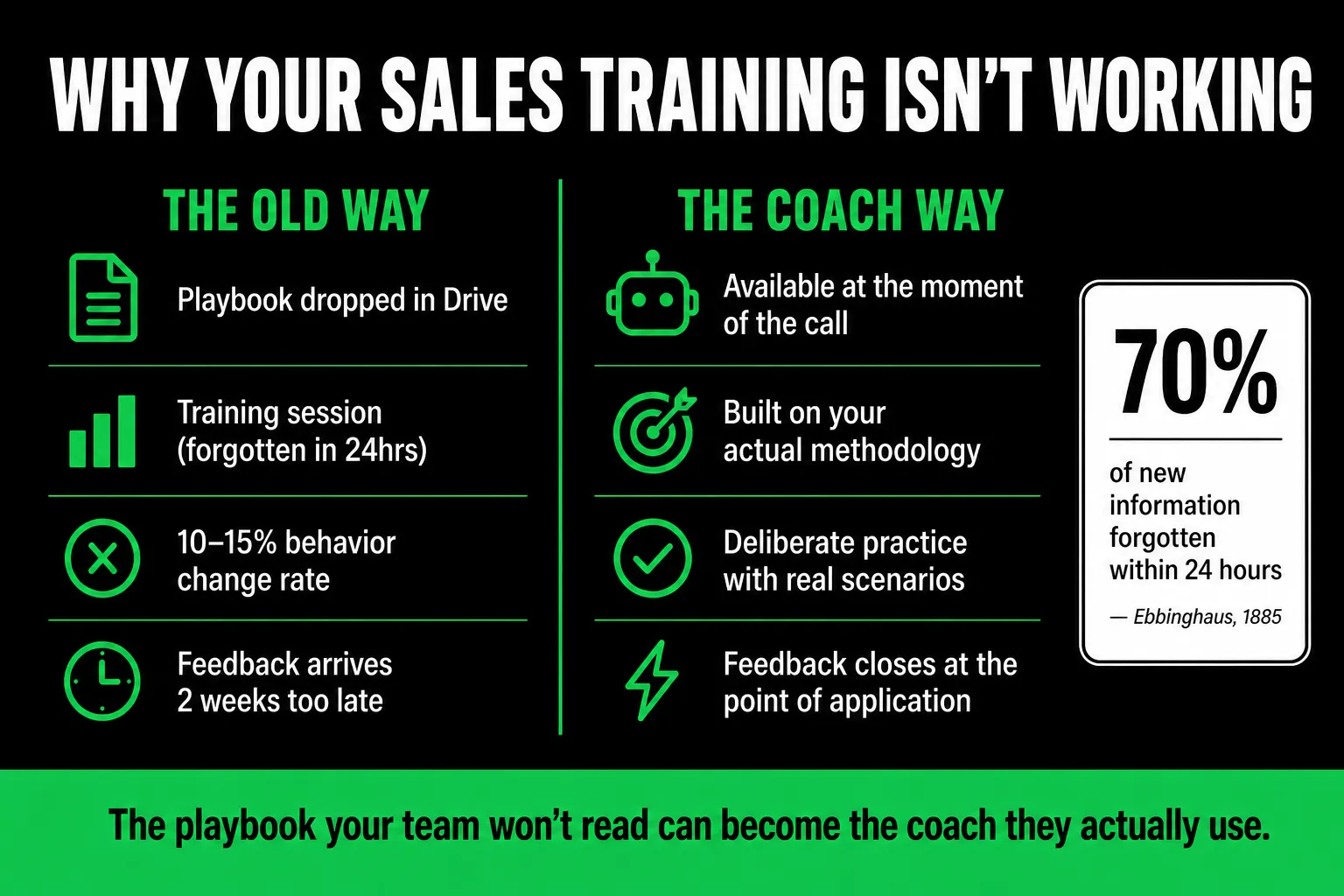
This isn't a problem specific to that team. Hermann Ebbinghaus established in the 1880s that people forget roughly 70% of new information within 24 hours without reinforcement, and research on training transfer puts the rate at which formal training actually changes behavior somewhere between 10 and 15% (Baldwin & Ford, 1988; Blume et al., 2010). The corporate training industry has been aware of these numbers for decades and has largely chosen not to let them interfere with the scheduling of training sessions.
The deeper issue is that we have been solving the wrong problem. When a sales rep fumbles an objection or loses track of where a deal stands, we diagnose it as an information gap and respond with better information. But the actual problem is behavioral: the rep hasn't yet developed the instinct to do the right thing under pressure, in a real conversation, with a skeptical buyer on the other end of the call.
Anders Ericsson spent decades studying how expert performers actually develop their skills, and his conclusion was clear: expertise comes from deliberate practice with immediate feedback, not passive absorption. Giving someone a playbook and expecting behavioral change is a bit like giving someone a manual on how to ride a bicycle. The information is correct. It is also almost completely useless for the actual task.
So I stopped trying to teach the team and built them a coach instead.
I fed everything into a custom GPT: the sales methodology, the frameworks, the objection-handling scripts, and examples of what strong discovery calls and at-risk deals actually look like. What came out was a private coach built entirely for their context, their product, and their specific challenges.
The coach runs on an adaptation of John McMahon's MEDDICC framework, which McMahon outlines in The Qualified Sales Leader. MEDDICC structures deal qualification around seven dimensions: the metrics of the business problem, the economic buyer who controls budget, the decision criteria, the decision process, identifying pain, the internal champion, and competition. For a team without a sales background, the full framework would have been overwhelming. I adapted it into five practical areas they could apply week over week: clarify the problem, strengthen the champion, access power, map the decision process, and improve your position.
Every time a rep brings a deal to the coach, it follows the same sequence. It identifies which of the five areas is weakest, surfaces what evidence is missing, and suggests three concrete next moves: one to create urgency, one to access the real decision-maker, and one to reduce the risk of the deal stalling.
It gives exact language. Not principles to apply later, but the actual sentences a rep can use in the next call, offered in a softer and a more direct version, with a brief explanation of why each approach works. The rep isn't absorbing a concept. They're practicing a real conversation.
The coach also knows when to push back. If a rep presents a deal as strong but has never spoken to the economic buyer, the coach flags it calmly. If a deal has been described as "progressing" for three weeks with no measurable change in position, the coach raises whether continued time investment is genuinely warranted, or whether the smarter move is to reallocate attention elsewhere. It doesn't shame. It develops judgment.
What makes this work isn't the technology. It's the timing and the context. The coach is available at the exact moment a rep needs to think through a situation, not two weeks later when the deal has already gone cold. The feedback loop closes at the point of application, which is the only point where feedback actually changes anything.
Reps started using it before calls to prepare, after difficult conversations to debrief, and when they kept fumbling the same objection.
Within a few weeks, the conversations started sounding different. Team members who had been struggling for months began saying "now it clicks." Not because the right words were finally found in a meeting, but because they had something that thought alongside them at the exact moment they needed it.
Most companies approach this in the wrong order. They acquire an AI tool and hope it will create clarity. It won't.
The coach worked because we had already defined the methodology clearly enough to feed it. The framework had to exist before the AI could reinforce it. Vague process in, vague coaching out. This is, perhaps, the one area in business where you genuinely do get out exactly what you put in.
The temptation, as AI tools become easier to access, is to treat them as a substitute for doing the harder strategic work of defining how your team should operate. They're an amplifier, not a foundation. If what you're amplifying is unclear, you'll produce more noise faster.
If you have a methodology, a set of best practices, or a playbook sitting dormant in a shared drive, you already have most of what you need. A custom GPT built on your actual process isn't complicated to set up and doesn't require a technical team.
The question worth sitting with: are you giving your people information, or are you giving them practice? The playbook your team won't read could become the coach they actually use.
If you want to explore what building one looks like for your team, reply to this post or book a 45-minute call. Happy to walk through the approach.
Sources
Ebbinghaus, H. (1885). Über das Gedächtnis (Memory: A Contribution to Experimental Psychology).
Baldwin, T.T. & Ford, J.K. (1988). Transfer of training: A review and directions for future research. Personnel Psychology, 41(1), 63–105.
Blume, B.D. et al. (2010). Transfer of training: A meta-analytic review. Journal of Management, 36(4), 1065–1105.
Ericsson, A. & Pool, R. (2016). Peak: Secrets from the New Science of Expertise. Houghton Mifflin Harcourt.
McMahon, J. (2021). The Qualified Sales Leader.