
I used to walk into my management team’s offices almost every day with a new “cool idea.” And when I say “cool,” I mean I thought it was cool. The team probably thought, please, dear god, not again.
I would show up like a hyperactive product manager who had just discovered Post-its. Bursting with energy. Eager to collaborate. Completely unaware of the chaos I was about to create.
My intentions were good. I’m a good man. But each visit landed like a small earthquake. You could almost hear people’s mental servers spinning up just to process whatever I was about to unload.
It took a while to admit it, but I was not inspiring anyone. I was frying their cognitive circuits. And doing it with enthusiasm, which somehow made it worse.
Some leaders obsess over completeness. We want to share all the context, the reasoning, the backstory, even the philosophical detours nobody asked for. Meanwhile, the team is silently begging for clarity, not a director’s cut of our internal monologue.
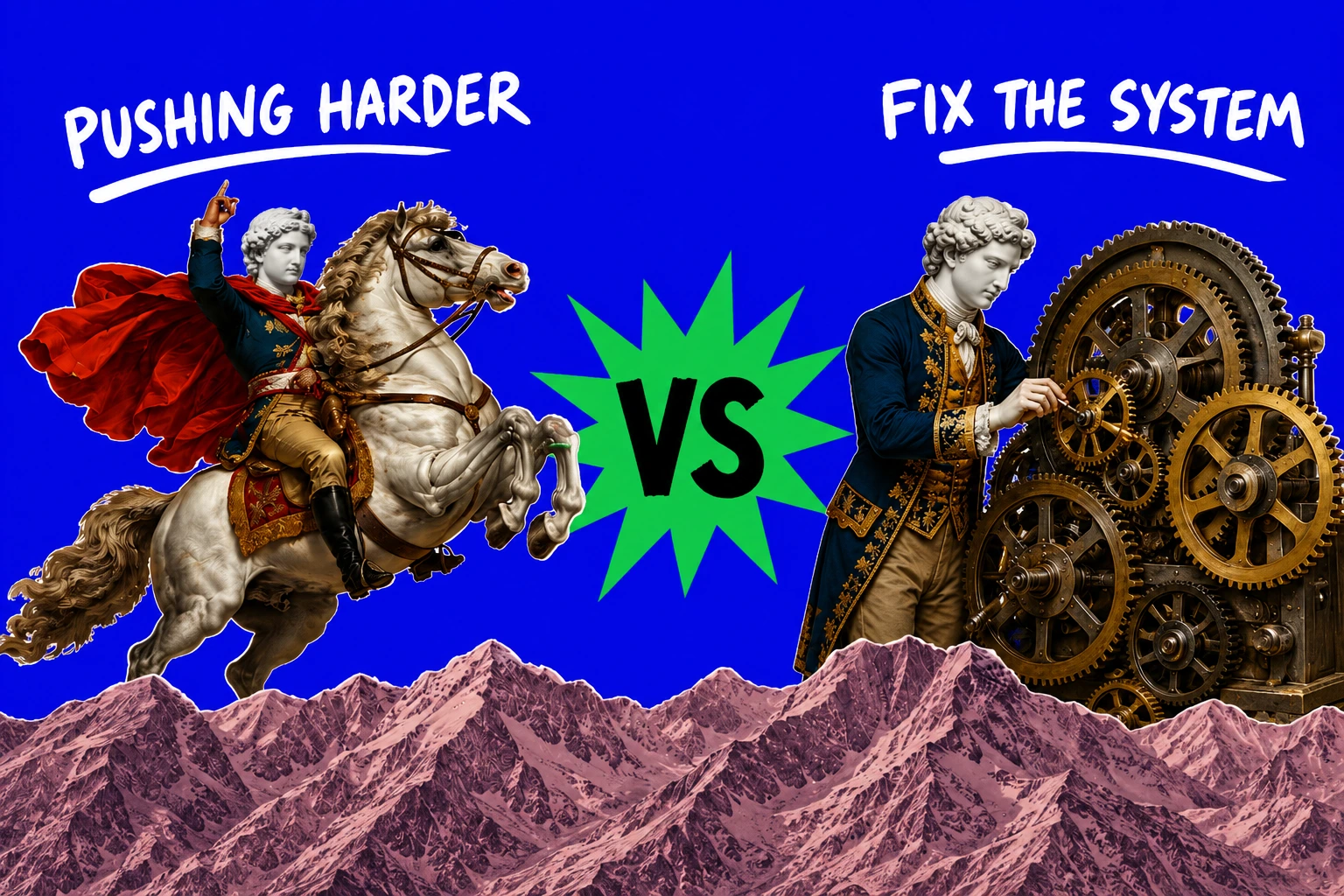
Saint Exupéry wrote us: “Perfection is achieved not when there is nothing more to add, but when there is nothing left to take away.” I read that and nodded like a zen monk. Then immediately added ten more priorities to the roadmap.
Eventually, the message sank in. Simplicity is not minimalism. It is a service to your team. The human brain has limits, and Cognitive Load does not negotiate.
That is when Progressive Disclosure started making sense to me. Not just as a UX idea. As a leadership survival tool. Teams can handle complexity, but not all at once, and definitely not because their CEO had a fun thought during breakfast.
Once I realized my own behavior was disrupting execution, I shifted my focus from sharing ideas to shaping habits. That is where Atomic Habits became useful. James Clear talks about identity based habits, and it forced me to ask a simple question. What identity had I created for the company? Were we a team known for brainstorming? Or a team known for delivering?
Clear’s point is simple. People do not rise to the level of their goals. They fall to the level of their systems. And those systems are shaped by identity. If you see yourself as someone who follows through, you act that way. If your team sees itself as a group that completes work, habits form around that identity. Identity becomes the compass for every small action that follows.
If I was honest, we had become a team drowning in interesting ideas and starving for follow through. And no amount of passion compensates for inconsistent execution.
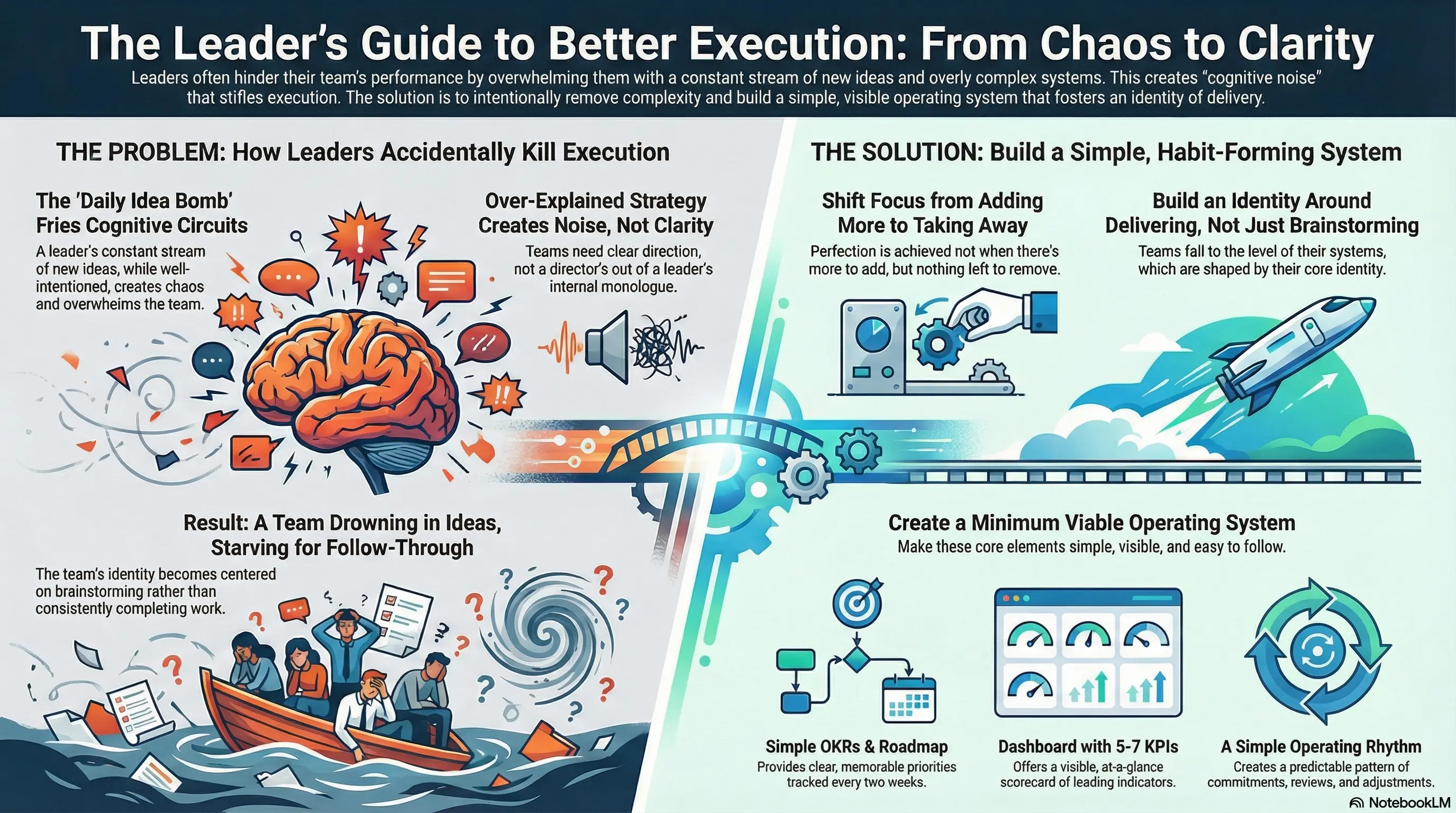
This is where our operating system started to change. We simplified how we set priorities. We used OKRs not as a Silicon Valley performance theater, but as a tool for focus. I have never believed in OKRs as a growth chasing mechanism. I believe in them as a mechanism for intention and alignment. Priorities should help teams breathe, not suffocate under the weight of unrealistic stretch goals.
James Clear’s habit principles helped here too. He talks about making habits obvious, easy, attractive, and satisfying. Most companies do the opposite. They bury their operating system under layers of documentation, create Notion pages that nobody has opened in four years, and build massive strategy decks that get used once in an All Hands and then vanish into archive purgatory. Everything becomes so complex that no one can follow it, let alone update it.
What helped me was identifying the minimum viable elements of our operating system. We created a dashboard with a few key leading indicators so the team could see where we were heading and adjust before it was too late. We focused on a handful of well oiled processes that actually mattered, like inbound sales and client focused delivery. We kept OKRs simple enough that everyone could remember them without needing to consult a 40 page document.
Once the system became simple, it became visible (because it wasn’t spread out across dozens of pages in the black hole of Confluence). And once it was visible, it became easier to follow. These small design choices made execution feel lighter. People did not have to dig through three platforms to find out what mattered. They could see it at a glance, which meant they could act faster and more confidently.
Here a couple of elements I like to have:
I like an operating rhythm that is simple enough to repeat without friction. Just a clear pattern of commitments, reviews, and course corrections. Enough structure to reduce chaos, but not so much that people needed a second calendar to manage the first one.
Once we cut the noise, something surprising happened. Our execution speed improved almost immediately. Forecasting became more reliable. Cross functional projects stopped feeling like hostage negotiations. People finished things. People took ownership. People stopped bracing for my next idea storm. And we ended up cancelling many meetings because we knew what we had to do.
Within two months, we transformed how we operated. Not through heroics or over caffeinated brainstorms. Through simple, repeatable habits that the whole company could rely on.
I have seen the same pattern when working with founders on strategy, org design, and scaling impact. Great teams do not scale because they are brilliant. They scale because their habits support their goals.
This is why I always come back to simplicity. While clarity is oxygen for teams, noise is the enemy. Leaders often believe they are helping by sharing everything. In reality, we are often creating friction. The more complexity we introduce at the wrong moment, the slower execution becomes. Minimum Viable Tests have helped me think in small next steps instead of creating another big scary and risky project.
Habits are the antidote. Identity based behaviors. Clear rhythms. Priorities that fit inside a human brain. And a leadership style that respects cognitive limits instead of bulldozing them. When these elements line up, execution becomes easier, faster, and more consistent.
If you want better execution, resist the urge to add more. Remove the noise. Remove the daily idea bombs. Remove the cognitive clutter. Make the system simple enough for real people to run it.
And if you ever find yourself walking toward someone’s desk with a new idea you are excited about, pause for a second. You might be on the verge of launching a cognitive Denial of Service attack. Save the idea. Protect the team’s bandwidth. Respect the habits you want them to build.
Execution grows out of simplicity. And simplicity starts with us.
*****************
If people look nervous when you walk toward them with a notebook, it is probably a sign. More practically, you will notice slow decision making, shifting priorities, and teams that never seem to finish things. Those are often symptoms of idea overload, not incompetence.
Start by removing what no one uses. Old Notion pages, forgotten processes, strategy decks from 2021. Strip your system to the minimum viable pieces that matter. A simple weekly rhythm, a small set of OKRs, and one or two visible dashboards usually do more for execution than a complex playbook or trying to document every single process in your business.
Keep them light. One objective per team. A few measurable key results. No inspirational paragraphs or multi slide explanations. OKRs work when they are simple enough to remember and stable enough to guide action.
Design the environment so the right actions are obvious and easy. Make priorities visible. Keep metrics simple. Shorten the time between action and feedback. Teams build habits the same way individuals do. You do not force it. You make the desired behavior effortless.
If you want a more structured approach to scaling your team’s execution, take a look at our Managing Growth course. It is designed for leaders who want clarity, alignment, and a system that actually supports performance.