There's a version of this conversation I've had at least a dozen times. A founder or CEO brings me in because the company isn't moving fast enough. When I ask what's wrong, I get some version of the same answer: "We have great people, but I can't get them to execute."
So I start talking to the team. And almost without exception, I hear the same thing from the other side: "I'm not sure what we're actually supposed to be focused on right now."
It was the same company with two completely different diagnoses.
The problem isn't the people. The problem is that nobody told them clearly enough, and kept telling them, what winning looks like this quarter.
This is the part that makes it hard. When priorities are foggy, the symptom looks like a motivation problem or a skills gap. People seem distracted. Delivery is inconsistent. Good performers start hedging their bets, working on multiple things at once, because they've learned that what's "urgent" shifts. The team looks slow. It isn't slow. It's navigating ambiguity, which burns a different kind of energy than doing focused work.
(If confusion were a product, most companies would be market leaders.)
I call it the fog tax. Every hour spent figuring out what matters is an hour not spent on the work itself. In a 50-person company, even if half the team pays that tax for just 30 minutes a day, you've lost 125 hours a week to fog. That's three full-time salaries spent on internal confusion. We wrote about this dynamic in more depth in Why Teams Struggle to Execute, the pattern shows up in almost every company we've worked with.
The people who pay that tax the most are your best people. They're the ones who care enough to try to figure it out. They ask questions, they reread the strategy doc, they try to infer from what the CEO said in the last all-hands. They're working hard at the wrong thing: trying to decode what they should already know.
Most founders I work with are genuinely good communicators. They give talks. They write well. They can hold a room. So when I tell them their team is unclear on priorities, they push back: "I've said it multiple times. It's in our OKRs. We covered it in the last offsite." (The OKR deck was beautiful, by the way. Really great font choices.) To be honest, I've said that myself many times.
But saying something is not the same as it being understood. And understood is not the same as internalized. The research on this is consistent: people need to hear a priority message somewhere between five and seven times, across different contexts, before it actually changes their behavior. Not because they're slow, but because they're busy, they're human, and they have competing signals coming at them from every direction.
Add to that the fact that leaders rarely communicate what they're not doing. A company might have three genuine priorities. But it also has forty things that feel like priorities because someone senior cares about them.
If you announce the three things without explicitly retiring the other forty, people are left holding everything. And they default to whatever seems most urgent in the moment, which usually means responding to whoever is loudest, not whoever is most important. (If you've ever wondered whether your OKRs are making this better or worse, this article on why you're probably using OKRs all wrong is worth a couple minutes of your time.)
Here's the part that hits hardest when I lay it out: unclear priorities are a talent retention problem, not just a productivity problem.
High performers have low tolerance for fog. They didn't take the job to figure out what their job is. They took it to do something meaningful at pace. When the environment is unclear, they don't disengage immediately. They try harder first. They ask more questions, they write memos hoping to surface the right answer. But there's a limit. At some point, the effort of making sense of the fog outweighs the reward of staying. And then they leave.
They rarely leave with a big speech. They just start looking, quietly. And by the time you notice, it's too late to fix it with a retention bonus. (LinkedIn has made this very easy for everyone involved.)
I saw this up close at one of my client engagements. There was a high-potential woman on the team who was visibly frustrated. Competing priorities, constant context-switching, no clear signal on what actually mattered. At an offsite, while the CEO was talking, I watched her face. She looked like she was about ten seconds from jumping across the table. She wasn't angry at him personally. She was exhausted by the fog.
What changed things wasn't a new strategy doc. We started bringing her into leadership meetings. She participated in the strategy session, became an active contributor in how the company set direction. Within a few weeks, she was a different person. Energized, engaged, fully in. The work hadn't changed. Her relationship to the direction had.
That's not a morale story. That's a clarity story.
The irony is that companies often lose their best people right when they're scaling, precisely because growth introduces complexity, new teams, new priorities, and leaders haven't yet built the communication systems to keep clarity consistent at scale.
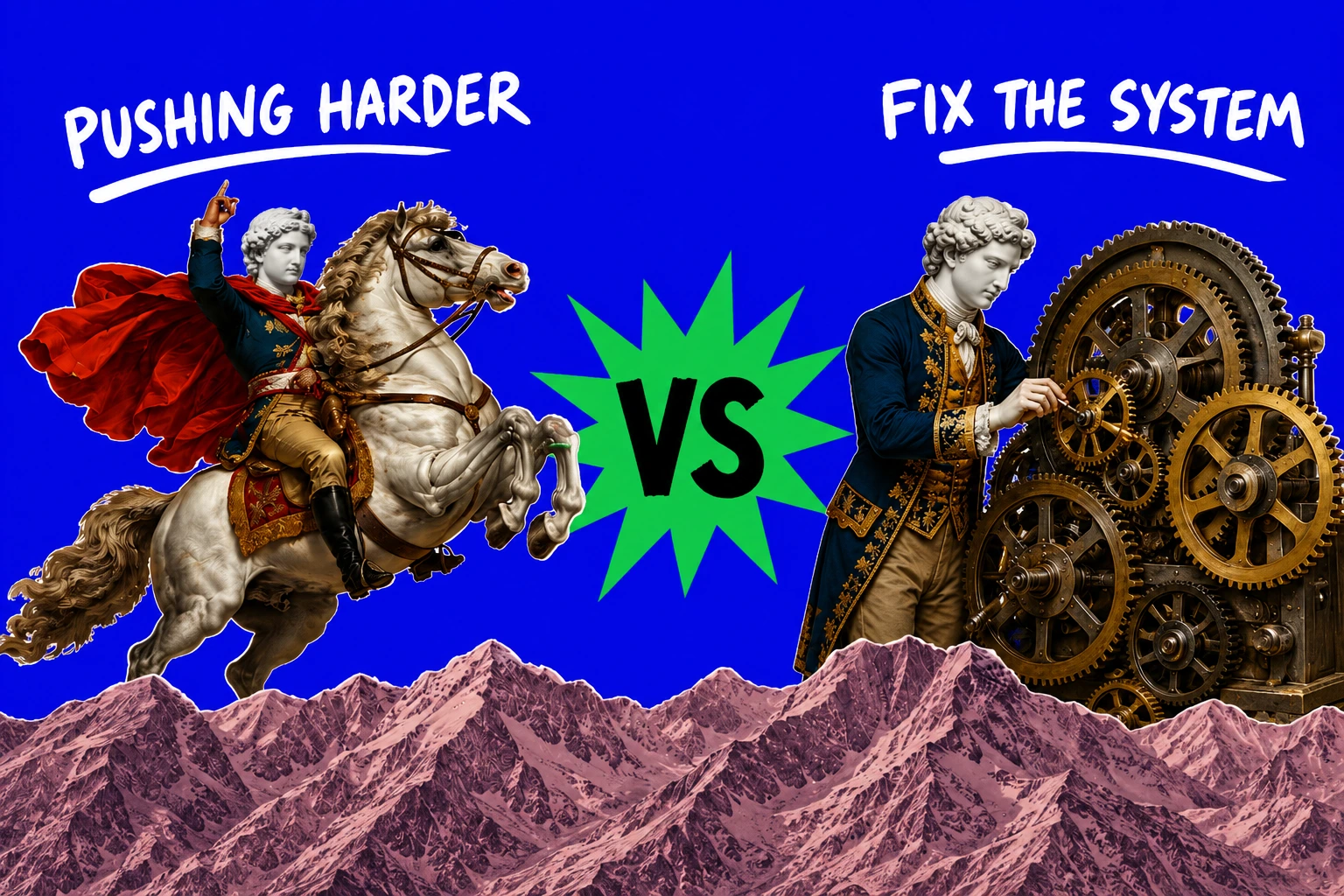
Clarity isn't a single conversation. It's a system.
It means communicating the same three priorities so many times you're bored of saying them. It means starting every leadership meeting with a quick alignment check: what are we focused on, what are we not focused on, has anything changed. It means making decisions transparently, so when something gets deprioritized, people understand why, and don't spend two weeks wondering if they missed something.
It also means modeling focus from the top. If you, as the CEO, are visibly scattered, jumping between projects, asking about things that aren't on the priority list, firing off ideas in Slack at midnight, your team learns to scatter too. They mirror your behavior, not your strategy document. (That strategy document, incidentally, is now on page 10,357 of a Notion folder nobody has opened since Q2.)
Jeff Bezos figured this out the hard way (I'm not a big Bezos fan, but I can seperate the message from the messenger). At Italian Tech Week in 2025, he recalled that early in Amazon's life, one of his executives, Jeff Wilke, pulled him aside and told him plainly: "Jeff, you have enough ideas to destroy Amazon." When Bezos asked what he meant, Wilke said he had to release work at a pace the organization could actually absorb.
Every idea Bezos released was another item dropped into an already strained queue. As Bezos put it: "Every time I released an idea, I was creating a backlog of work in process. And because it was just stacking up, it was adding no value. In fact, it was creating a distraction." He started keeping ideas to himself until the organization was ready for them.
If that lesson was non-obvious to Bezos, it's non-obvious to most founders. The instinct is to share, to energize, to move fast. But velocity at the top doesn't become velocity at the bottom unless the organization has the clarity and the bandwidth to channel it.
The fastest companies I've worked with aren't faster because they have more people or better tools. They're faster because every person on the team wakes up knowing exactly what matters today. That's not a talent problem. That's a leadership design problem. And it's one of the most fixable things in a company.
Ask five people on your team, individually, not in a group, to name the company's top three priorities right now. Don't prime them. Just ask.
If you get five different answers, you don't have a performance problem. You have a clarity problem. And now you know exactly where to start.
If you want to go deeper on what it takes to fix it systematically, here's how we approach it.