
Your revenue has been flat for two years. Not declining, not growing, just flat. You added eight people in that time. Gross margin dropped four points. Your pipeline is still 70% relationships you personally own, and your leadership team is capable, aligned on paper, and somehow still not moving the things that matter.
You know what's broken. You've known for a while. The harder question is why every fix you've tried has treated the symptom instead of the system.
At some point the idea of bringing in outside help surfaces. An experienced operator who has fixed this before. Someone who can see what you're too close to see. And then you talk yourself out of it. Not because the idea is bad, but because you have five very specific concerns, and every consultant you've ever met has failed to address them honestly.
Here they are.
This is the most earned objection in the room. You paid for a framework. You got a presentation. The team nodded, filed the deck, and reverted to exactly the behaviors that created the problem in the first place.
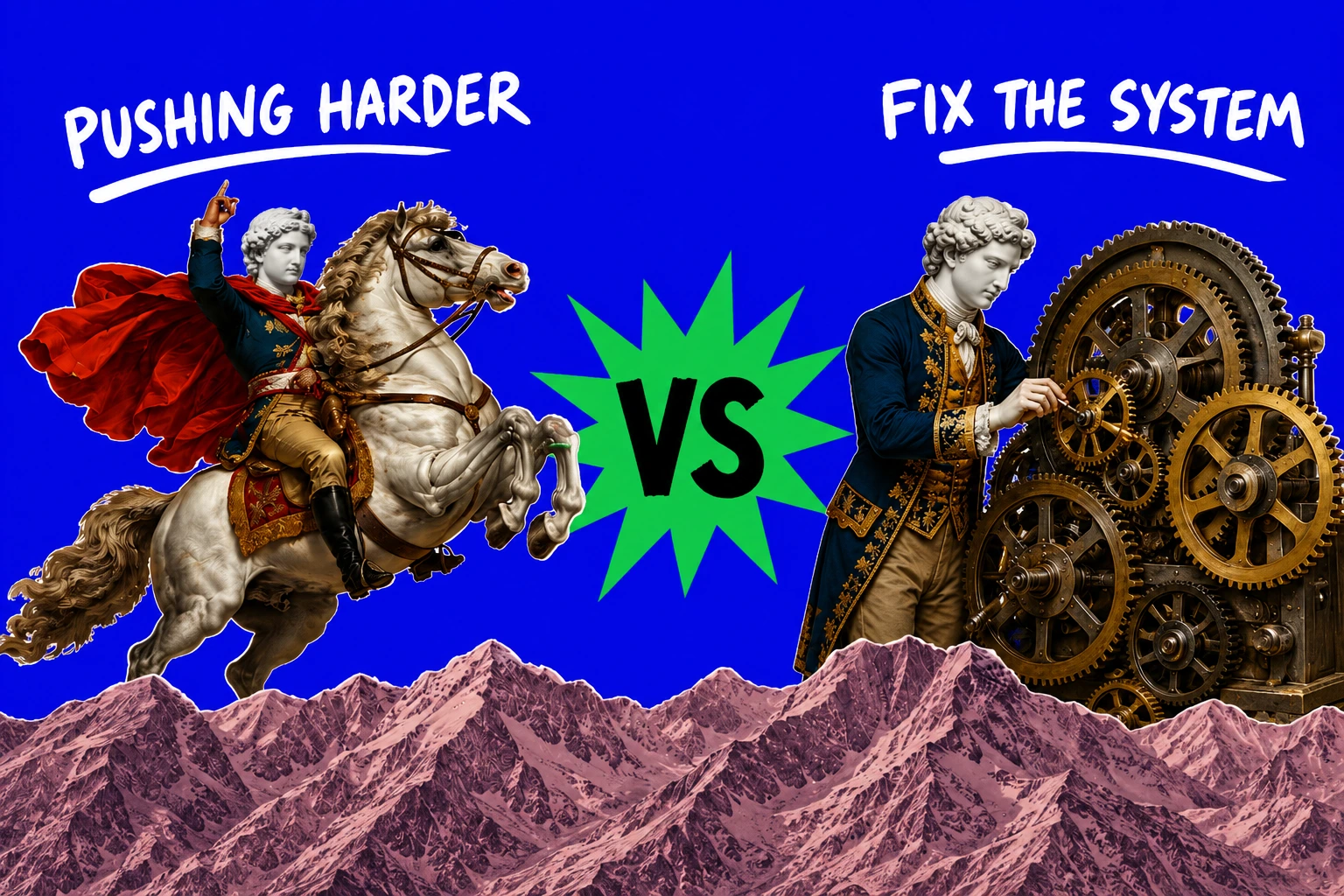
That happens for a structural reason: most consulting engagements are designed around the consultant's deliverable, not the client's operating system. The implicit assumption is that a smart team with a good framework will figure out the rest. That assumption is wrong for companies at your stage. The problem is not that your leadership team lacks frameworks. It is that the operating system — how decisions get made, who owns what, how accountability actually works, how AI gets used in daily workflows — has never been rebuilt to match the company you are now rather than the one you were at €1M.
The question worth asking any outside engagement is not what they will deliver. It is what will be running differently when they leave. A handoff document is not the answer. A leadership team operating a different system is.
The engagement I run ends with a written handoff and a team that runs the rebuilt system without me. Not managing a transition. Running it. That distinction is the whole game.
This is almost always true. You are making decisions that three levels of your organization should be handling without you. Your calendar is full of recurring meetings that produce discussion but not decisions. Adding an onboarding process and weekly check-ins on top of that is genuinely unappealing.
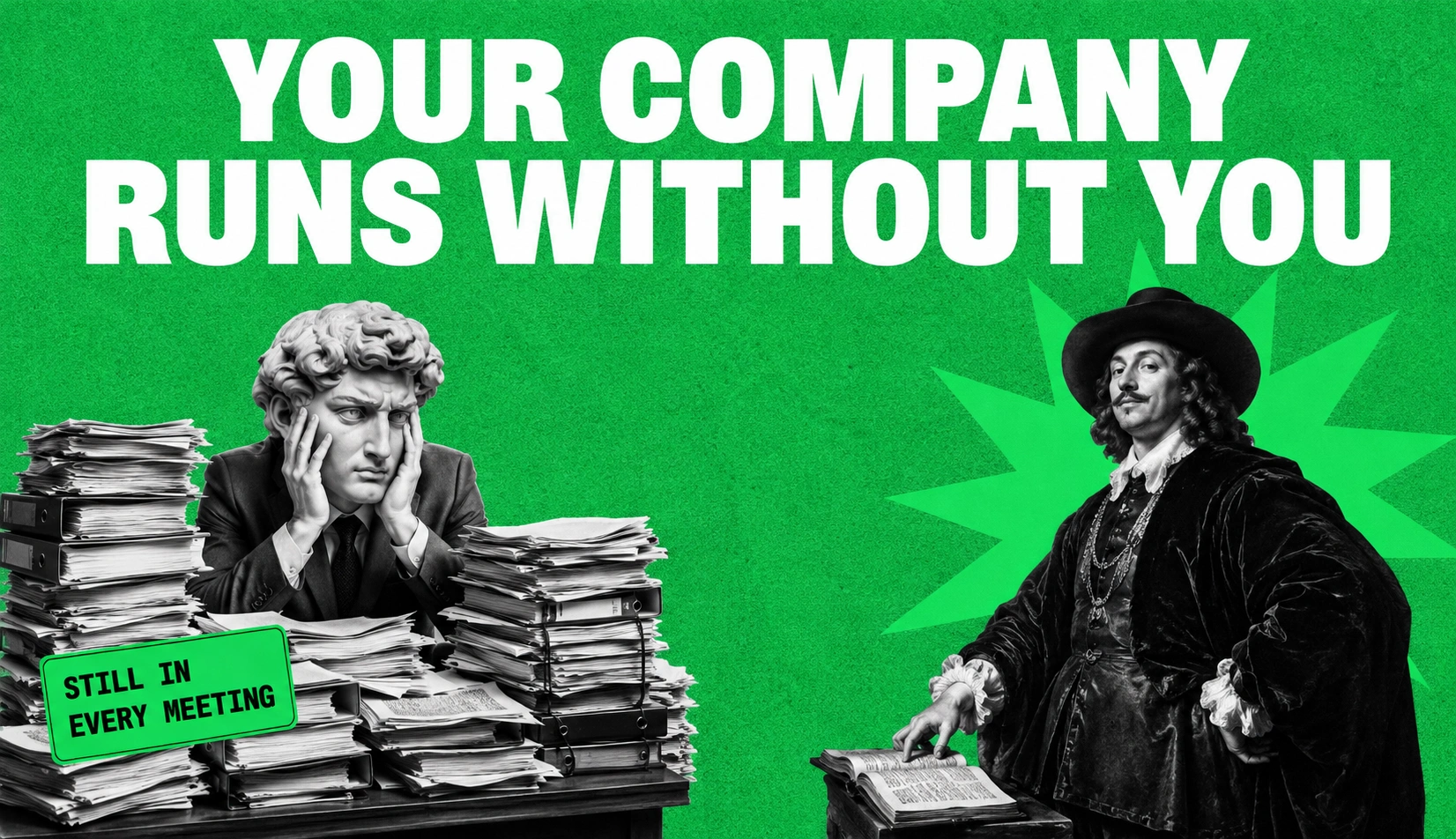
But look at what is actually consuming your time. You are reviewing pricing exceptions because no one else has clear authority to approve them. You are in product roadmap discussions that your head of product should be running without you. You are still on later-stage calls with enterprise prospects because the sales process was never built to work without the founder in the room.
The bandwidth problem is not a reason to wait. It is exactly the problem the engagement fixes. Most leaders report being less involved in operational decisions by week four because the first sprint is built around identifying the two or three places where your involvement is structural rather than optional and removing those dependencies.
What the engagement asks of you is real: honest conversation at the start, hard decisions when the analysis surfaces them, and follow-through when the answer is uncomfortable. What it does not ask is daily availability, process management, or babysitting.
You have sat through enough confident generalist advice dressed up in your terminology to be skeptical of anyone who claims to diagnose your company in a week. That skepticism is earned.
The distinction worth making is between industry knowledge and execution pattern recognition. Industry knowledge — your customer dynamics, competitive landscape, regulatory context — takes months to acquire from the outside. Execution pattern recognition transfers in days, because the underlying failure modes are structurally the same across companies.
A founder who is still the primary closer on enterprise deals after the company reaches 50 people is running the same structural problem whether the product is a SaaS compliance tool or a professional services firm. A leadership team that has five weekly meetings and still takes three weeks to make a pricing decision is running the same accountability failure regardless of sector. Revenue that grew from zero to €2M on founder energy and then stalled for 18 months is hitting the same wall everywhere.
What the diagnostic surfaces in the first week is where decisions are getting made slowly, where ownership is blurry versus politically sensitive, and where the gap between stated priorities and actual team time is widest. None of that requires sector expertise. It requires someone who has seen the pattern enough times to name it fast.
I will tell you directly in the first conversation what I can see clearly from the outside and what would take more time to understand. That is the honest version of the answer.
This points to a real failure mode: a long discovery phase that produces insight with no output, followed by recommendations that arrive after the problem has mutated into something else.
The diagnostic is not a six-week process. The first conversation runs 60 to 90 minutes. You walk away with a written read on your real bottleneck and at least one decision you can make this week. By day seven, the leadership team has aligned on which problem to fix first and why. That alignment alone is worth the meeting, because most leadership teams are privately operating on four different theories about where the company is stuck.
By week six, the benchmark I hold myself to is this: AI is producing real daily work product inside the company. Not a pilot, not a demo, actual output your team would otherwise have paid people to produce. Decisions that were taking two to three weeks are taking two to three days. At least one initiative that was consuming team energy without producing results has been killed or redirected.
The engagement runs in three phases. Days one to seven: diagnostic and shared map. Days eight to sixty: build and install, covering strategy clarity, accountability, AI workflows, and the operating rhythm. Days sixty-one to ninety: consolidate and hand off, ending with a written 90-day forward plan owned by the team, not sitting on my laptop.
You feel the change before any spreadsheet confirms it. Decisions get made. Initiatives reach completion. The leadership team stops being the approval layer for everything below it.
This is the most honest objection, and it deserves a direct answer rather than a features list.
If revenue is flat and margin is compressing, adding a significant external cost feels like the wrong move. Protecting cash when growth stalls is sound instinct. It is also sometimes exactly the move that extends the stall.
Here is the actual calculation. A leadership team of four or five people at €120K to €200K each costs €600K to €900K a year. A meaningful fraction of that cost is going toward decisions that never get made, priorities that have been on the quarterly plan for three quarters without resolution, an AI rollout that was announced in January and produced nothing by March, and a sales process that still requires the founder on every deal above €30K. The operational waste inside that cost base is almost always larger than the engagement fee.
The question is not whether the investment is large. It is whether what it fixes is worth more than what it costs. That is a calculation I would rather you make clearly than sell past.
The diagnostic call is where that conversation starts. Thirty minutes, no commitment, no pitch. You leave with a sharper read on what is actually broken and at least one move to run this week regardless of what you decide. If the numbers genuinely do not support moving forward after that conversation, you will know more than you did going in.
Each of these objections is reasonable. Each is also asking the same thing in a different register: is this actually going to be worth it?
That is a fair question. It is also one that can only be answered after someone has spent an hour inside your business and understood what is specifically stuck and why.
Six months from now, the calendar will have moved. The question is whether your operating system moved with it.
Book a 45-minute diagnostic call. I run a small number of these each week. Worst case, you walk away with a clearer picture of your real bottleneck. Best case, we build something that runs.